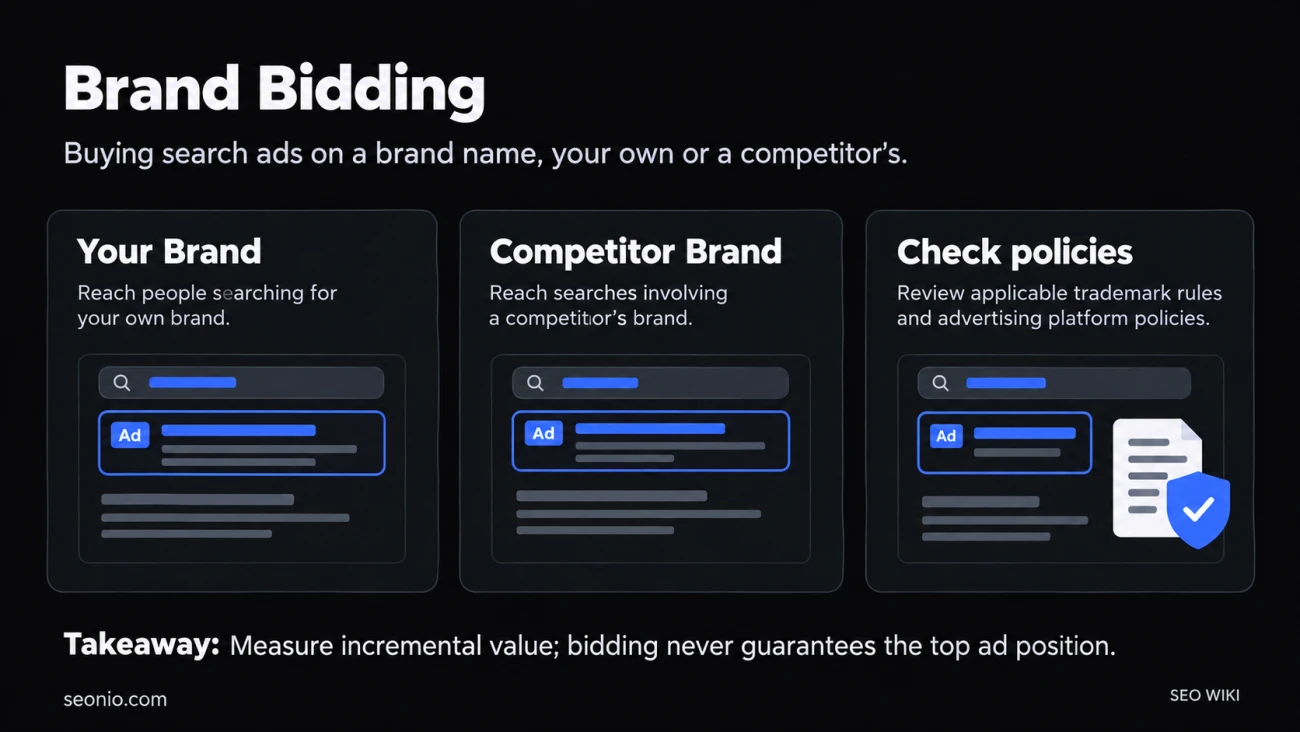
Brand bidding is buying paid search ads on keywords that contain a brand name. When someone searches for that brand, your ad can appear above the results. It's also called trademark bidding.
There are two kinds, and they answer different questions:
- Bidding on your own brand (often called defensive brand bidding): should you pay for people who are already looking for you?
- Bidding on someone else's brand (competitor bidding or conquesting): should you show your ad to people looking for a rival?
Affiliates and resellers bid on brand names too, which is why brand owners write rules about it into their partner agreements.
Bidding on your own brand
People who type your brand name usually want you. Your organic result often sits at the top already, so paying for those clicks can look like a waste. The reason brands do it anyway: if you don't bid, a competitor's or affiliate's ad can sit above your organic result.
Brand clicks are often cheap for the owner. In Google Ads, your position comes from Ad Rank, which weighs your bid against the quality of your ad and landing page. An ad for your own brand, leading to your own site, is about as relevant as an ad can be. Google says higher quality ads can often lead to lower costs per click. Google Ads Help
To find out whether your brand ads earn their money, run a holdout test:
- Pause brand ads in some regions, or for some weeks, and keep them running elsewhere.
- Compare total brand clicks and conversions, paid plus organic, between the two groups.
- If organic clicks make up nearly everything you lost and no competitor moves in, your brand ads add little. If competitors take the top spot, the ads are protecting real traffic.
Bidding on a competitor's brand
A rival's brand searches come from people who already want what you sell, so a few may consider an alternative. Most of them still want the brand they typed, though, so expect fewer clicks and a higher cost per click than on your own name. Your ad is less relevant to that search than the brand owner's ad is.
What helps:
- A landing page made for that search, for example a fair comparison of the two products.
- Ad text that says what you offer, without the competitor's trademark in it (see the rules below).
- A limit on what a conversion may cost you, so a bidding war doesn't eat the budget.
What Google allows with trademarks
Keywords: Google Ads doesn't restrict trademarks as keywords. Anyone can bid on your brand name, and you can bid on theirs.
Ad text: After a trademark owner complains, Google reviews the case and may restrict the trademark in ad text. It restricts ads from direct competitors that use the trademark, and ads that use it in a confusing, deceptive or misleading way. Resellers, sellers of compatible parts and informational sites aren't restricted, as long as the ad and landing page make clear what kind of site it is. Google accepts complaints only against specific advertisers, identified by their URLs, in the countries and industries where the owner has shown trademark rights. Google Ads policy
The law: In the EU, the Court of Justice ruled on 23 March 2010 (Google France v Louis Vuitton) that Google doesn't infringe trademark law by letting advertisers buy competitors' trademarks as keywords. An advertiser can infringe, though, when its ad makes it impossible or hard for average internet users to tell whose goods or services it offers. Court of Justice of the EU Other countries have their own rules, so get legal advice for the markets you advertise in.
Keeping control of brand terms in Google Ads
Brand traffic often ends up in the wrong place by accident rather than by plan. These settings decide where it goes:
- Match types. Exact match keeps brand keywords to brand searches. Broad match can pull in related searches, including other brands. See match types.
- Negative keywords. Add competitor names you don't want to appear for, and add your brand to generic campaigns so brand searches stay in the brand campaign. Negatives only change your own ads. See negative keywords.
- Auto-apply recommendations. When turned on, Google can add keywords for you, including broad match keywords. Turn them off, or review the queue, if you need strict control over brand terms.
- Brand inclusions. These limit a Search campaign to searches related to the brands you list, so it stops showing on searches without a brand name. Google is moving them into the AI Max settings of Search campaigns; new brand lists need AI Max turned on.
- Brand exclusions. These stop a campaign from showing on searches for brands you pick, including misspellings and variants. Google introduced them for Performance Max; they're now available for Search campaigns too. If a campaign has both, exclusions win. Google Ads Help
Two reports show what's happening. The search terms report lists the searches your ads actually showed for. Auction insights shows which other advertisers appear in the same auctions as you, how often, and how often they rank above you. A new name there for your brand keywords means someone has started bidding on your brand.
Affiliates and resellers
Many affiliate programs forbid partners from bidding on the merchant's brand, because the merchant would pay a commission on a customer who was already searching for it. If an affiliate's ad shows up for your brand, check whether your agreement allows it before you act. Sometimes it's a broad match keyword or an auto-applied recommendation in the partner's account, not a deliberate choice.
Authorized resellers are a different case. Google lets them use a trademark in ad text when they actually sell the product, so a reseller ad on your brand may be allowed under Google's policy even when you'd rather it weren't. Your reseller agreement is where you set those terms.