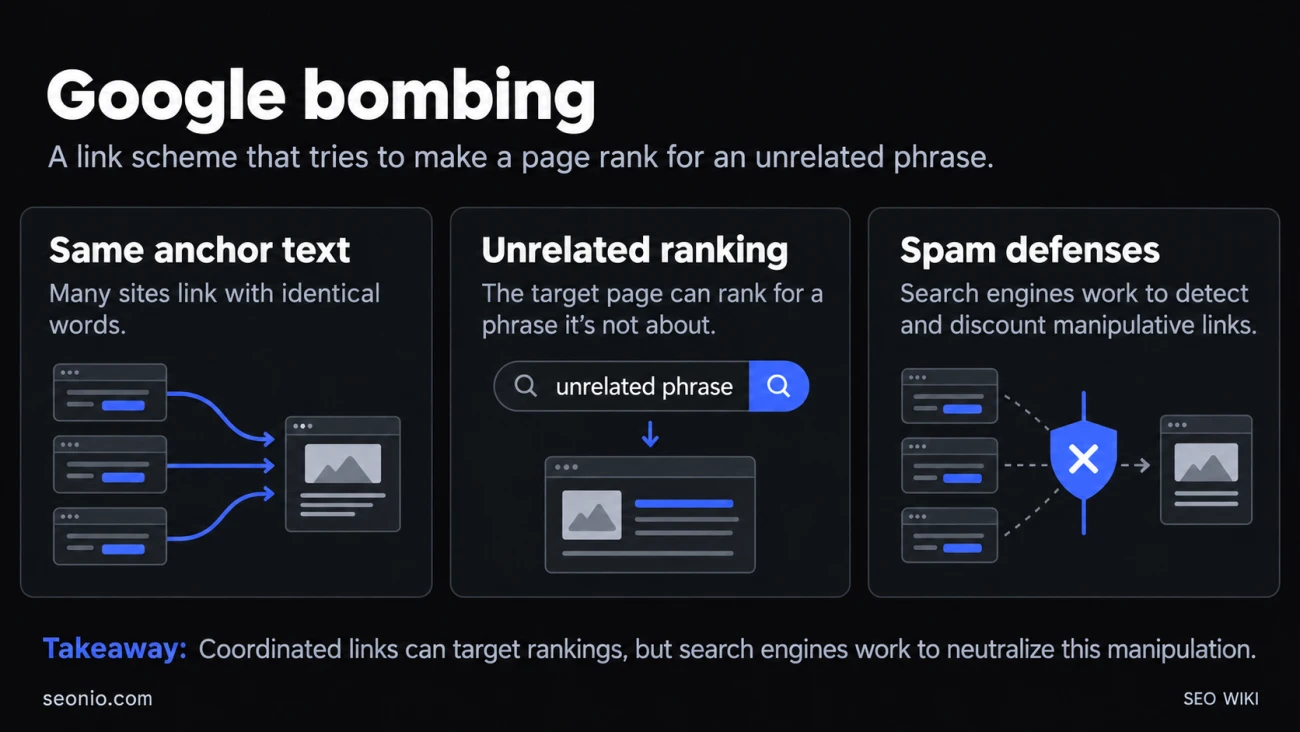
A Google bomb, also called a link bomb, is a prank in which many people link to the same page with the same words, so that the page ranks for a phrase that has nothing to do with it, often a mocking one. The target page doesn't need to contain the phrase at all. The links do the work.
Google bombs were a running joke of the early 2000s web. Today they're mostly history, but they still explain why search engines treat links and their wording with suspicion.
How a Google bomb worked
Search engines read anchor text, the clickable words of a link, as a short description of the page it points to. If hundreds of pages link to one page with the words "talentless hack", a search engine may conclude the page is about a talentless hack.
Early Google ranked pages in large part by the number and popularity of the sites linking to them, the idea behind PageRank. That made coordinated linking powerful. It only worked for obscure phrases, though. Google pointed out that bombs very rarely succeed for common queries, because the lack of any relevant page for the phrase is part of what lets the prank win (Google Search Central Blog).
The best-known examples
Google itself named two:
- "talentless hack", which Google called one of the earliest Googlebombs.
- "miserable failure" and "failure". In September 2005 the top Google result for both was the White House's official biography of President George W. Bush. Google explained that webmasters had linked to the page with those words. It said it didn't condone the practice but was reluctant to edit results by hand (Official Google Blog).
Users had started to believe these results were Google's opinion. That misunderstanding, more than the pranks themselves, pushed Google to act.
What Google changed in 2007
On January 26, 2007, Google announced that it had improved its analysis of the web's link structure and was now minimizing the impact of many Googlebombs. For bombed phrases, it would typically show commentary and articles about the Googlebomb instead of the target page.
Google stressed three points:
- The change was small in scope: there were under a hundred well-known Googlebombs.
- It was an algorithm, not a hand edit, so it also worked in other languages.
- It didn't claim to catch every prank.
Does Google bombing still work?
Don't count on it, and don't try it. Google's spam policies now treat creating links mainly to manipulate rankings as link spam, including links made with automated programs (Google spam policies). Since December 2022, Google has said it uses its SpamBrain system to neutralize the effect of unnatural links. A coordinated burst of identical anchor text is the kind of unnatural linking that work is meant to discount.
If you see strange link text pointing at your site, open the Links report in Search Console and check Top linking text. A few odd anchors are normal and usually ignored. A sudden flood of spammy links is a different worry, covered under negative SEO.
Google bombing vs similar terms
| Term | Goal | Method |
|---|---|---|
| Google bombing | Make a page rank for an unrelated or mocking phrase | Many links with the same anchor text |
| Google bowling | Push a competitor down in the results | Spammy links aimed at the competitor, hoping Google punishes them |
| Spamdexing | Rank your own pages higher | Spam tricks on your own pages or links |