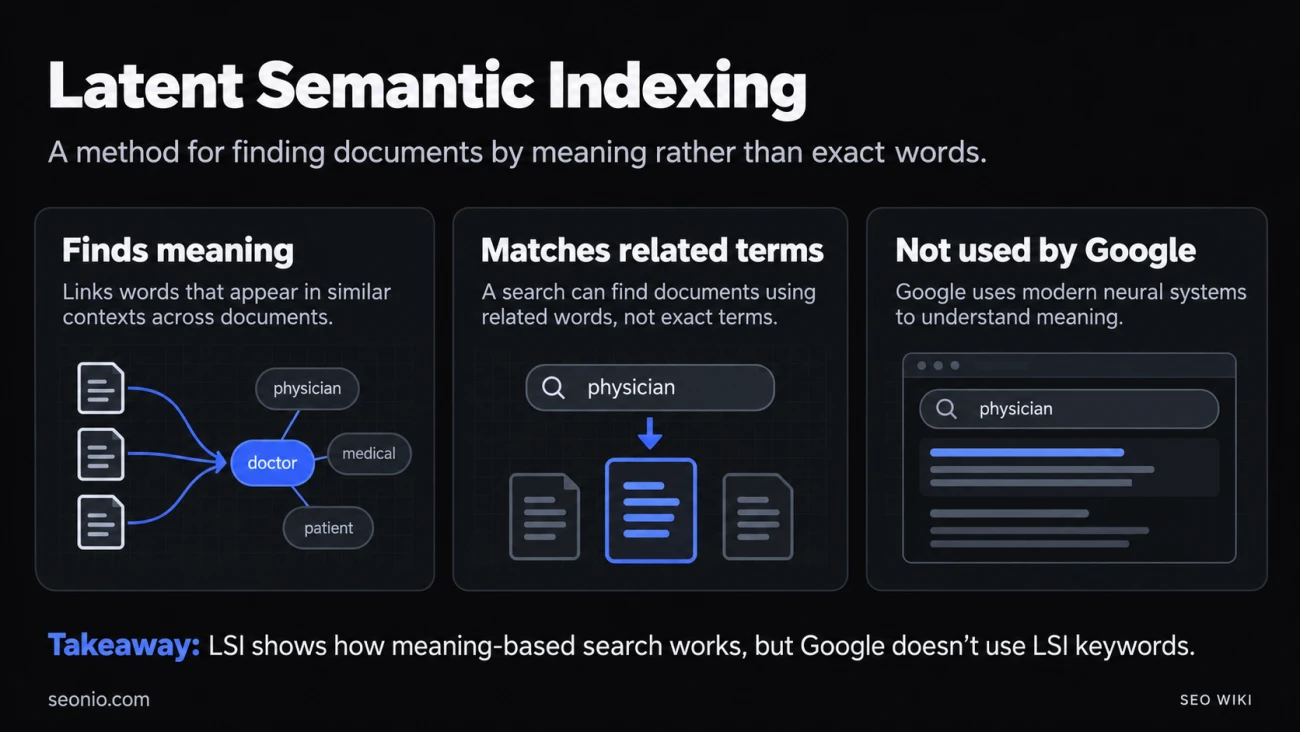
Latent semantic indexing (LSI) is a method for finding documents by meaning rather than exact words. It analyzes which words appear together across a collection of documents, then matches a search to documents that use related words, even if they don't contain the search terms themselves.
LSI was invented at Bellcore in the late 1980s; the US patent, "Computer information retrieval using latent semantic structure," was filed in 1988 and expired in 2008. The same method used outside search is called latent semantic analysis (LSA). If you came here because a tool suggested "LSI keywords," the short answer is below: they aren't a thing Google uses.
How LSI works, in brief
LSI builds a large table of words by documents and compresses it with a matrix method (singular value decomposition) into a few hundred dimensions. Words that appear in similar contexts end up close together in that compressed space. A search query is placed in the same space and matched to the documents nearest to it.
That lets a search for "physician" find a document that only says "doctor." Its strength is recall: finding relevant documents that share no exact words with the query. Its weaknesses: it ignores word order, mixes all meanings of a word into one point, and needs recalculating as the collection changes a lot. The LSA article covers the math.
Does Google use LSI?
No. In 2019, John Mueller of Google answered a question about LSI keywords on Twitter: "There's no such thing as LSI keywords -- anyone who's telling you otherwise is mistaken, sorry." John Mueller on X
The systems Google does document for understanding meaning are neural ones. BERT helps it understand how combinations of words express meaning and intent. Neural matching relates concepts in queries to concepts in pages. RankBrain helps it understand how words relate to concepts, so it can return relevant pages that don't contain all the exact words searched.
And even where LSI was used, it was something a search system ran over its whole collection, not a set of words a page could contain.
What "LSI keywords" really are
When SEO tools or articles say "LSI keywords," they usually mean synonyms, related phrases or common subtopics for a keyword. For "coffee grinder," a tool might list "burr grinder," "grind size" and "espresso." These lists don't come from latent semantic indexing, and Google doesn't look for them.
Related words aren't useless. A page that fully covers a topic naturally uses the words people associate with it. The mistake is the method: pasting in a list of terms to hit a quota. That can turn into keyword stuffing, which is against Google's spam policies.
What to do instead
Google's SEO starter guide gives the real version of the advice. People who know a topic search with different words than beginners, for example "charcuterie" versus "cheese board," so write with your readers' words in mind. But don't worry about covering every variation: Google's language matching can understand how a page relates to many queries, even without the exact terms Google SEO starter guide.
In practice:
- Find what searchers want to know. Look at the top results, People Also Ask questions and related searches for your keyword.
- Answer those questions fully. Cover the subtopics a reader would expect, in the order they'd ask them.
- Write naturally. Use the words your readers use, including synonyms where they fit. Don't repeat one phrase, and don't add terms nobody would miss.
This is the idea behind semantic SEO and topical authority: show that a page and a site cover a subject well, rather than matching a word list.
Where LSI is still useful
Outside Google, LSI remains a workable method for search in smaller document collections, such as an internal knowledge base or a document archive, and for grouping similar documents. Its authors note it has been used most widely for small databases. Many new projects use neural embeddings and vector search for the same job.