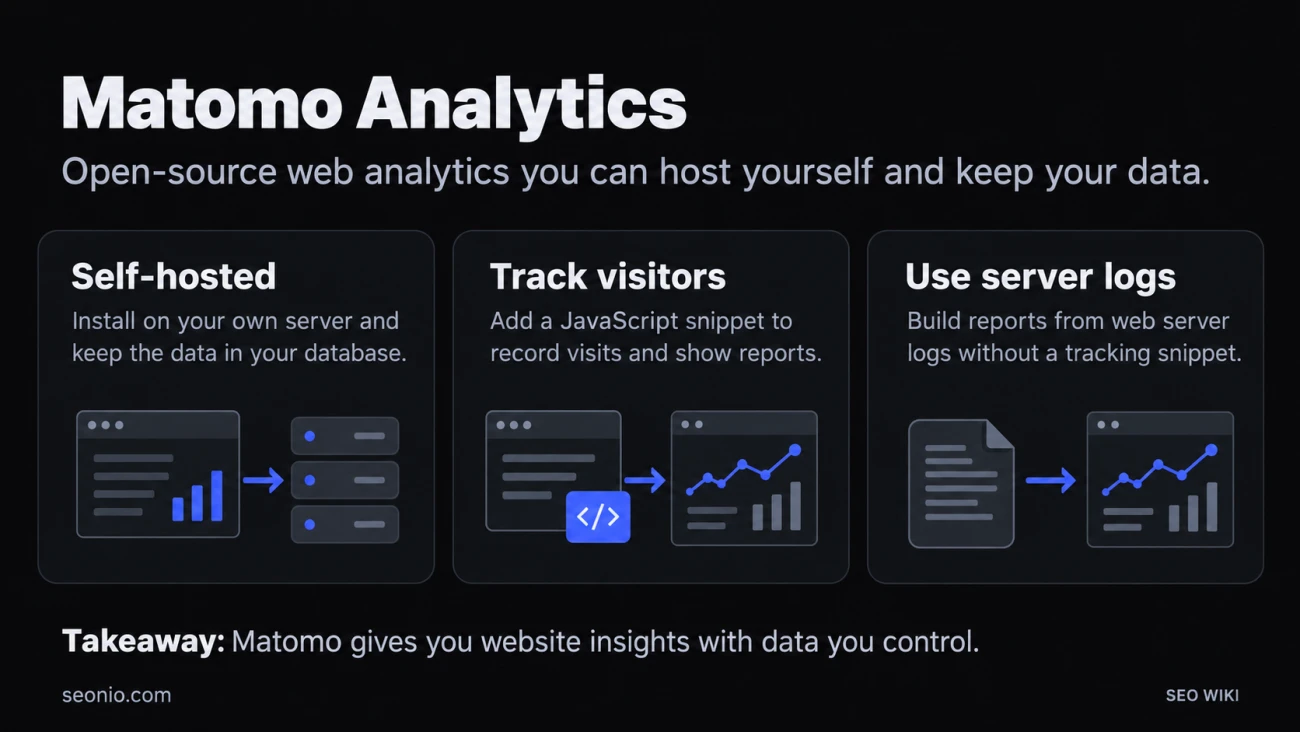
Matomo is a web analytics platform: like Google Analytics, it records visits to your website or app and turns them into reports on pages, traffic sources, conversions and visitors. The difference is ownership. Matomo is open-source software you can run on your own server, so the data stays in your database instead of a vendor's. Until January 2018 it was called Piwik (Matomo).
Two ways to run Matomo
On-Premise means you install Matomo on your own server. The software is free, and the core, its JavaScript tracker and most plugins are released under the GPL v3 license (Matomo license FAQ). You need a web server with PHP and a MySQL or MariaDB database; the requirements page lists PHP 8 for Matomo 5, and PHP 8.1 with MySQL 8.0 or MariaDB 10.6 for Matomo 6 (Matomo FAQ). You also handle updates, backups and security yourself.
Matomo Cloud is the hosted version. Matomo runs the servers and you pay a subscription; there's a 21-day free trial. It suits teams that want Matomo's approach without maintaining a server.
There's also a WordPress plugin that runs Matomo inside a WordPress site.
How it collects data
The usual setup is a JavaScript snippet on every page, like other analytics tools. By default it records the page URL and title, the referring page, the visitor's IP address, approximate location, browser, device, screen resolution and language, plus downloads and clicks on outbound links. It also sets first-party cookies to recognize returning visitors, and you can turn those off (Matomo FAQ).
Matomo can also skip the snippet entirely. Its Log Analytics feature builds reports from your web server's access logs (Apache, Nginx, IIS and others), including logs from before you installed it. Some reports aren't available that way, such as events, heatmaps and screen resolution. If you work with server logs already, see log file analysis.
Do you still need a cookie banner?
It depends on where your visitors are and how you configure Matomo. Matomo's own FAQ is careful here (Matomo FAQ):
- Under strict ePrivacy-style rules, as in the EU and UK, client-side analytics generally needs consent, even without personal data.
- France, Spain, Italy and the Netherlands exempt limited, privacy-friendly analytics from consent, but only under conditions such as anonymized data, no cross-site tracking and an opt-out.
- Features that process personal data, track for marketing or share data with third parties usually need consent anywhere.
So Matomo can make consent-free analytics possible in some countries, with IP anonymization and cookies turned off, but it doesn't remove the question. Matomo itself recommends treating JavaScript tracking as needing consent until a regulator says otherwise; its server-side Log Analytics stores nothing on the visitor's device, which Matomo notes is clearly outside Germany's device-access rules. Check the rules that apply to you; see GDPR and cookie for the background.
Matomo or Google Analytics?
| If you care most about... | Consider |
|---|---|
| Keeping visitor data on your own servers or in a chosen region | Matomo On-Premise |
| A free tool with no server to run | Google Analytics |
| Close links to Google Ads and other Google products | Google Analytics |
| Open-source code you can inspect and change | Matomo |
Google Analytics is far more common. W3Techs counts it on 82.1% of the websites whose analytics tool it can identify, against 2.4% for Matomo, as of October 2026 (W3Techs). Matomo points out that its reports are unsampled, meaning they're based on all the data you collected.
If you switch, a free plugin imports your Google Analytics properties, so you keep your history.
Matomo for SEO
Matomo shows organic search as a traffic channel, with landing pages and conversions per page, like any analytics tool. Most of the search terms behind those visits show up as "Keyword not defined", so keyword data has to come from the search engines' own tools. A premium plugin, Search Engine Keywords Performance, imports keyword data from Google Search Console, Bing Webmaster Tools and Yandex Webmaster into Matomo, next to your visits and goals.
That plugin is one of Matomo's premium features. They're sold separately under their own license, while the core stays free and open source; the keywords plugin, for example, comes with a 30-day free trial. Heatmaps, session recordings and funnels are premium plugins too, so add their cost if you're comparing Matomo with free tools.