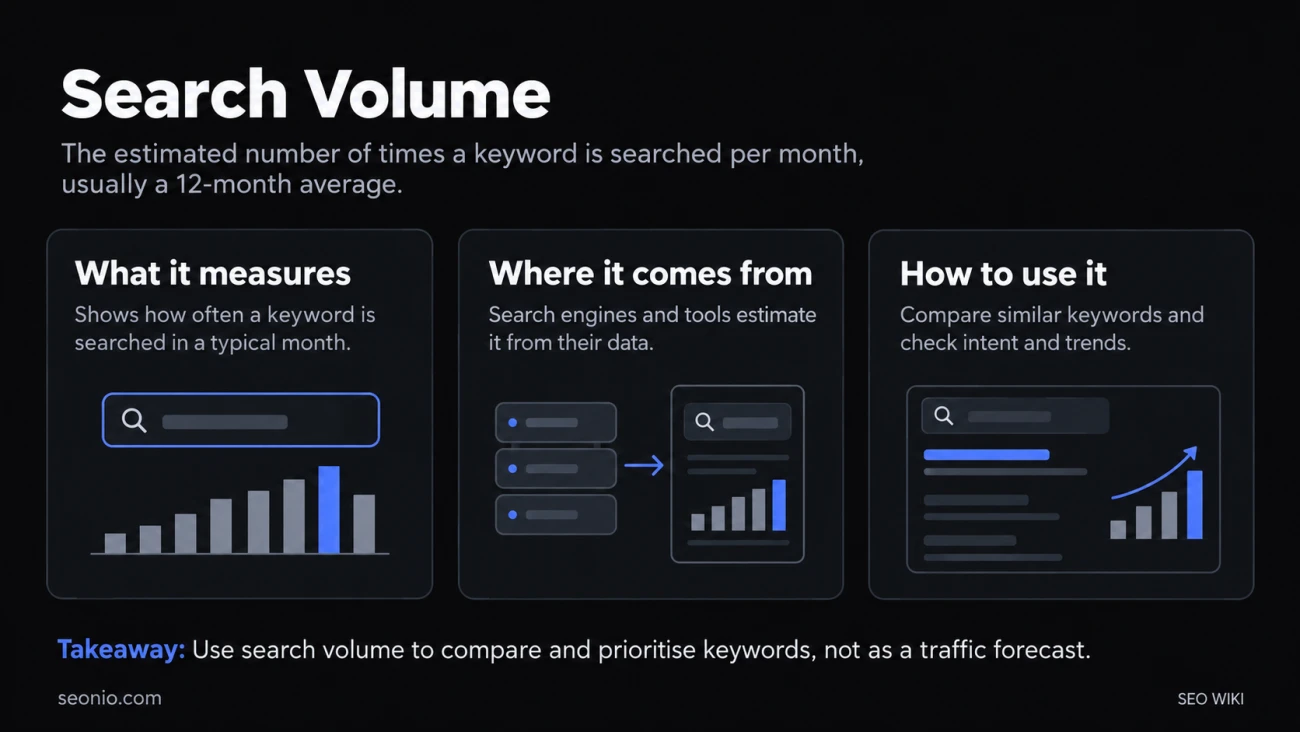
When a keyword tool shows 1,000 next to a keyword, that's its search volume: an estimate of how many searches the keyword gets in a typical month, in one country or region, usually averaged over the last 12 months. Some months may be far above or below that average.
It's the first number most people look at in keyword research, because it tells you how many people a topic could reach. It doesn't tell you how many of them will reach your site.
Where the numbers come from
Only the search engine knows exactly how often something is searched. Everyone else works from what it shares:
| Source | What it gives you |
|---|---|
| Keyword Planner in Google Ads | Average monthly searches straight from Google, for the locations, network and months you pick |
| Keyword research tools | Their own estimates, built from search engine data and other sources; figures differ between tools |
| Google Trends | Relative interest on a 0 to 100 scale, not a count of searches |
| Google Search Console | Impressions: how often your own site was seen for each query, not the total number of searches |
Google defines Keyword Planner's figure as the average number of searches for a keyword and its close variants, for the months, location and network you selected, averaged over 12 months by default. The figures are rounded, so volumes for several locations may not add up as you'd expect. Google Ads Help
Google Trends works differently. It takes a sample of searches, divides each point by the total searches in that place and time, and scales the result from 0 to 100. The result shows relative interest, so 100 doesn't mean 100 searches. It's good for seeing seasons and comparing terms; see relative search volume.
What the number can't tell you
Search volume counts searches, not visits. Treat it as an estimate with blind spots:
- Searches aren't clicks. Ads, an AI Overview or a featured snippet can answer the searcher before they click any result. Your share also depends on your position.
- Variants share one number. Google counts a keyword together with its close variants, so singular and plural, or small spelling differences, may show the same volume.
- An average hides seasons. "christmas lights" averaged over 12 months says nothing about December. Look at the monthly figures.
- Small keywords go missing. Keyword Planner can't find keywords with very low volume, and leaves out many it treats as sensitive, such as some health and finance terms. Google Trends shows low-volume terms as 0.
- Zero isn't nobody. A keyword with no reported volume can still bring visitors, especially long, specific searches. Search Console also hides rare queries for privacy, so you'll see clicks you can't match to a query.
How to use search volume well
Use it to compare and to rank priorities, not as a traffic forecast:
- Compare like with like. Look at keywords on the same topic, in the same country and language, from the same source.
- Weigh it against intent. Say "running shoes" shows 50,000 searches and "buy trail running shoes size 10" shows 300. The smaller one may bring more sales, because everyone searching it is ready to buy. That's search intent.
- Weigh it against difficulty. A big number means little if strong sites own the results. Check keyword difficulty and look at the results page.
- Check the trend. A rising keyword is worth more than its average; a falling one, less. Plan seasonal pages ahead of the peak, so they're indexed when demand arrives.
- Don't skip the small ones. A page can rank for many long-tail keywords at once, and their volumes add up.
The two example keywords above are illustrations, not measured figures. Check the real numbers for your own market, since volumes differ a lot between countries.