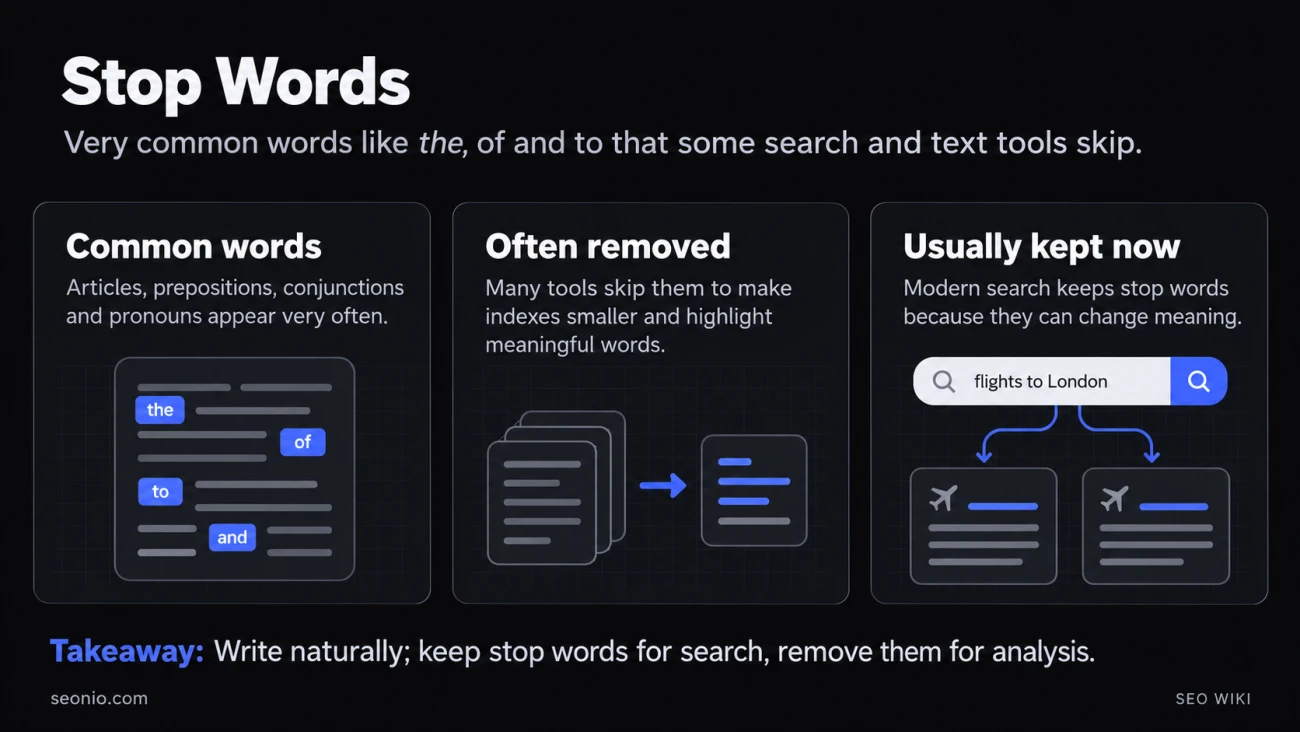
Stop words are a language's function words: articles, prepositions, conjunctions and pronouns such as the, a, of, to, and, in and it. They hold sentences together, but on their own they say almost nothing about what a text is about, which is why a search index gains little from recording them. A "stop list" is the set of these words that a particular search or text tool skips.
There is no single official list. Each tool ships its own, and most let you change it. Elasticsearch's default English stop list, for example, has 33 words, from a, an and and to was, will and with. Elastic docs
Why some tools drop them
Stop lists come from information retrieval, where an index records which documents contain which words. Words like the appear in nearly every document, so indexing them adds a lot of data and tells you little about what a document is about. Dropping them makes the index smaller and lets the meaningful words stand out. Text analysis does the same: word counts, topic models and word clouds are more useful without hundreds of thes at the top.
Why modern search usually keeps them
Removing stop words has a cost: sometimes they carry the meaning.
- Phrases fall apart. Porter's classic example is the search "to be or not to be", which is nothing but stop words. Snowball
- Names disappear. Say someone searches for the band The Who. Without stop words, nothing is left.
- Small words change intent. "Flights to London" and "flights from London" differ only by a stop word. So do "laptop with case" and "laptop case".
That's why stop word removal is no longer the default everywhere. Elasticsearch's standard analyzer, for one, keeps every word unless you switch a stop list on. Google describes its search as using language models to work out what the words of a query mean, rather than matching words one by one. It doesn't publish a stop list.
Google Ads is the one place where Google documents its handling. An exact match keyword can match searches that add or remove function words (prepositions, conjunctions and articles) that don't change the intent. Google's example: [shoes for men] is a close variant of [men shoes]. Google Ads Help See match types for how that affects your keywords.
What stop words mean for your copy
Mostly, write naturally. You don't need to strip stop words from titles or headings, and you shouldn't twist sentences to avoid them. "How to train a puppy" reads better than "train puppy", and it's what people type.
URLs are a style choice. Google's URL guidance asks for simple, descriptive words and says nothing about stop words. A shorter slug like /train-puppy-guide is fine, and so is /how-to-train-a-puppy. Remove small words only where the meaning survives, and don't change existing URLs just to shorten them. More on this under URL structure.
In keyword research, treat stop words as part of the keyword. "Books by Stephen King" and "books about Stephen King" ask for different things, and each phrase has its own search intent and search volume.
Stop lists in your own tools
If you run site search or analyze text, decide per job:
- Keep stop words for search where phrases, names or small words matter, which covers most site search.
- Remove them for counting and grouping, such as word frequencies, topic analysis or comparing the vocabulary of pages.
- Edit the list for your field. A legal site may need not and no; a music site needs the in band names.
Stop word handling is one of the basic steps of natural language processing, next to stemming.