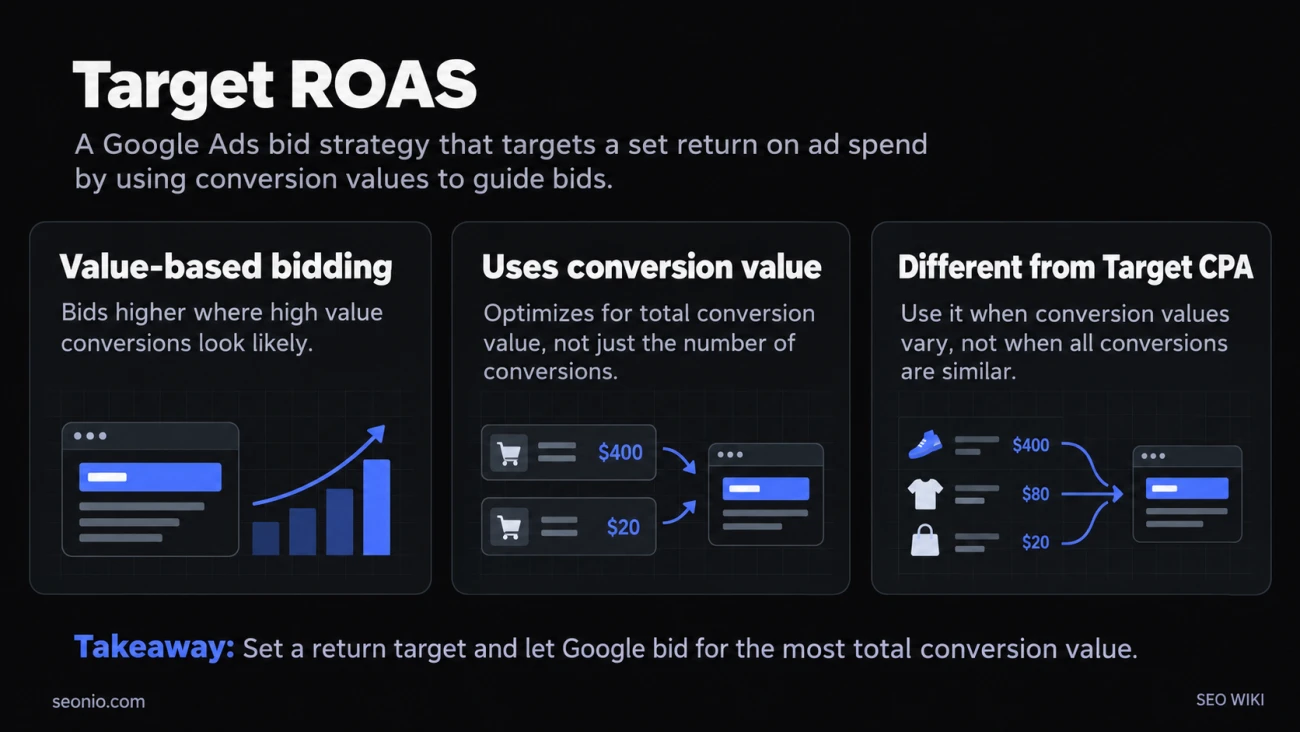
ROAS stands for return on ad spend: the conversion value you get back for each dollar of ads, written as a percentage. Target ROAS is the Google Ads strategy for advertisers whose conversions are worth different amounts, a $20 order and a $400 order, say. Instead of counting conversions, Google predicts the value of each auction, bids higher where a valuable conversion looks likely and lower where it doesn't, and tries to bring you as much total conversion value as it can at the average return you asked for.
Like Target CPA, it's part of Smart Bidding: bids are set at auction time using signals such as device, browser, location, time of day and your remarketing lists.
How the percentage works
ROAS is conversion value divided by ad spend, times 100%.
Google's own example: an online shoe store wants $5 in sales for every $1 it spends on ads. $5 ÷ $1 × 100% = a target ROAS of 500%. Some conversions will return more and some less; Google tries to keep the average at 500%.
The value is whatever you report with each conversion. For a store that's usually the order total. For a lead business it might be an estimated value per lead type. You can also add conversion value rules that raise the value for customer types, devices or locations that matter more to you.
From June 2026, Google Ads is relabeling "Maximize conversion value with a Target ROAS" as "Target ROAS". Both names mean the same strategy.
What you need before you start
You need conversion tracking with values, and enough recent conversions with a value above 0. The minimums depend on the campaign type:
| Campaign type | Minimum conversions |
|---|---|
| Search and Shopping | 15 in the past 30 days |
| Display | 15 in the past 30 days across all campaigns; new Display campaigns need no history |
| App | 10 a day, or 300 in 30 days |
| Demand Gen | 50 in the past 35 days in the campaign (10 of them in the past 7 days), or 100 in 35 days across all Demand Gen campaigns |
| Video action | 30 in the past 30 days |
| Hotel | 50 a week in the campaign |
| Travel | 50 in the past 7 days in the campaign |
Google's advice for moving from conversion counting to value: bid with Target CPA first, report values across all relevant campaigns for 4 weeks or 1 to 2 conversion cycles (whichever is longer), then set a target ROAS. Fewer, larger campaigns also tend to perform better, because each one has more conversions to learn from.
Check your budget too. On a busy day Google can spend up to twice your average daily budget, but over a month you're not charged more than 30.4 days of that daily budget.
How to set the target
Start from what you already achieve. In the campaign table, add the Conv. value / cost column and multiply it by 100: that's your current ROAS. Leave out the last few days, because conversions that arrive late make recent results look worse than they are. Google also recommends a target based on your actual ROAS over the last few weeks.
Then weigh it against your margins. Say your average margin is 40%: at 250% ROAS, each $1 of ads brings $2.50 in sales and $1 in margin, so you only break even before other costs.
The target controls the trade-off between volume and efficiency:
- A higher target asks for more value per dollar. Google enters fewer auctions, so traffic and total sales can drop.
- A lower target lets Google enter more auctions. You get more conversions at a lower return.
Change it in steps. The bidder reacts at once but needs 1 to 2 conversion cycles to settle at a new target, so judge a change only after that.
What the strategy ignores
Your existing bid adjustments aren't used with Target ROAS, with one exception: a -100% device adjustment still stops ads on that device. You don't need to remove the others; they just have no effect.
Bid limits (a maximum or minimum CPC) are available only for Search and Shopping portfolio strategies, apply in Search Network auctions only, and Google doesn't recommend them.
How to judge the results
Compare your actual ROAS with the Avg. target ROAS column, which averages every target the strategy used over the period. It's available for Performance Max, Search and Shopping campaigns.
Since August 17, 2026, campaigns limited by budget deliver closer to their target instead of beating it. If a campaign had been running well above its target ROAS, it may now move toward the target. Raise the target if you want to keep the higher return; Google won't change it for you.
Target ROAS or Target CPA?
Use Target ROAS when your conversions have different values and you have a return you need to hit, like a store whose orders range from a few dollars to a few hundred. Use Target CPA when every conversion is worth about the same, like newsletter sign-ups or one type of lead. Without any target at all, Maximize conversion value spends your full budget for the most value it can get. For the wider picture, see bidding strategy and Google Ads.